
Lemonade Insurance
25 December 2021, 6 min read
Introduction
A colleague introduced Lemonade’s business model and its value proposition while we were having a discussion which I found is quite interesting and would like to share.
Lemonade Inc. is an insurance firm that offers renters’ insurance, homeowners’ insurance, car, pet, and term life insurance. Their premiums start from as low as $5 per month.
Founded in 2015 by three co-founders, it has received the B Corporation certification just one year after it was founded. The B Corporation certification is awarded to businesses that demonstrate high social and environmental performance, accountability, and transparency on factors like employee benefits and charitable giving, which the latter is the topic of interest.
Below is the chronology of Lemonade Inc.’s funding:
- Seed: $13 million, Sequoia Capital and Aleph
- Series A: $13 million, XL Innovate
- Series B: $34 million, General Catalyst, Thrive Capital, Tusk Ventures, and GV
- Series C: $120 million, SoftBank
- Series D: $300 million, SoftBank, Allianz, General Catalyst, GV, OurCrowd, and Thrive Capital
- IPO: July 2020
Lemonade is registered as a public benefit corporation in the United States, which is a for-profit corporate entity that has its legally defined goals to create positive impact on society. Lemonade’s mission is to “transform insurance from a necessary evil into a social good”.
A unique value proposition of Lemonade is giving a portion of its underwriting profits to a nonprofit organization chosen by the policyowner/nominee upon signup. This is their way of making insurance less evil.
Insurance is Evil?
Insurance firms are for-profit organizations, which means higher premium amount, lower payout, and lower claim amount are better for the firms. To reduce claim frequencies, some firms deny claims made by their customers, or at least make claims that people do not like, as they are incentivized to hold onto claims for as long as possible.
Insurance firms are not necessarily evil (sometimes), however, due to their nature of being large corporations in a capitalist economy, the general public believes that they have the power to control whether or not customer claims will be approved.
To compensate on their premium paid to the insurance firms and to feel justified for paying high premiums, policyholders will try to screw up insurance companies by submitting false claims, in hopes of reducing the company’s underwriting profit as firms have been collecting premiums for years.
"Dishonesty is influenced a lot by our ability to justify it. If we are dealing with a party that we think is immoral itself than we [are immoral] and justify it. We think that everybody else cheats… it feels like a victimless crime.” - Dan Ariely, Chief Behavioral Officer, Lemonade Inc.
Read more about Dan's interview with TechCrunch here. More about Dan below.
GiveBack
To reduce the likelihood of claimants committing fraud, Lemonade came up with the GiveBack mechanism.
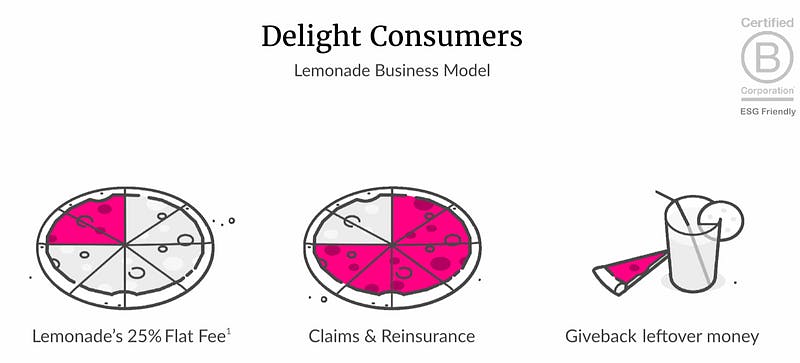
Lemonade takes a fixed 25% fee from premiums paid, and leave the 75% to pay claims and reinsurance. If there is leftover from the 75%, they will donate it to the customer’s preferred charity organization.
Its customers then will not have the incentive to screw up the company by committing fraud. This serves Lemonade’s purpose and its business model innovation to create relationship based on trust and transparency.
GiveBack program has donated over $2 million to 65 organizations around the world in 2021 alone.
Behavioral Economics
In 2016, Lemonade named Dan Ariely (as featured in the Real Value documentary and the best-selling author of The Upside of Irrationality, I particularly like his TedTalk using Legos as an example. ), as the Chief Behavioral Officer to implement an incentive system so bring back trust to the insurance industry.
Dan suggested Lemonade to take a flat 25% fee on every policy and the rest to go to charitable organizations.
He identified this scenario under a game theory branch, called the Public Goods Game, which is highly reliant on public trust. As long as everyone contributes, trust is a public good, and if everyone stops, fraud will take over trust. Unfortunately, trust is easy to break and hard to build and maintain.

Conclusion
Currently, Lemonade is serving the United States, France, Netherlands, and Germany. The insurance industry has an average net promoter score (NPS) of under 20, Lemonade has 70. An estimated 5% of claimants even returned the claim amount when a stolen or lost belonging was then found.
Experts expect Lemonade to ramp up their AI utilization and accuracy in approving claims, as the firm is hit hard by the COVID-19 pandemic and should take innovative approaches to recover.